
Solar Flares Could Bring The Northern Lights To Northern Illinois
If I'm reading a stack of meteorological data in front of me correctly, not only will all of us here in Northern Illinois soon be enjoying warmer temperatures (above freezing, anyway) starting late this week, we'll also possibly get to experience something that rarely happens in our area.
That would be a chance to view the Aurora Borealis, or Northern Lights.
Winter in northern Illinois hasn’t just been cold, it’s been relentless. But a recent burst of activity on the sun might deliver a completely different kind of spectacle, the aurora borealis far farther south than usual. And with a string of huge solar flares earlier this week, skywatchers are buzzing about the possibility of seeing colorful lights over the Midwest this Thursday and into the weekend.
Here’s how it works: huge explosions on the sun’s surface (solar flares ) can send clouds of charged particles racing toward Earth. When those particles reach our magnetic field, they can spark geomagnetic storms that light up the night sky near the poles. But sometimes, when the storms are strong enough, that amazing glow pushes farther south, becoming visible where it normally wouldn't be.

The Solar Flares Happened Just A Day Or So Back, So We Might See The Northern Lights As Early As Thursday And Through The Weekend
According to Forbes, on Monday and Tuesday of this week, an especially active region on the sun unleashed a series of powerful flares that are among the strongest so far this year. X-class flares are the most intense that are tracked, and when they’re pointed our way they can have real effects on Earth’s upper atmosphere and magnetic field.
What makes this week particularly promising is that those flares may have launched coronal mass ejections (CMEs), which are huge clouds of charged particles, in our direction, possibly arriving around Thursday.
If the timing and alignment are right, that could trigger a geomagnetic response strong enough to push the Northern Lights down into parts of the northern United States, including Northern Illinois and Southern Wisconsin.

Seeing The Aurora Borealis In Northern Illinois Is Rare, But It's Not Unheard Of
During the current solar maximum, which is the peak of the sun’s roughly 11-year activity cycle, geomagnetic storms have already brought the Northern Lights to parts of the nation that usually never get them. And when conditions are favorable, observers in dark sky areas well outside of major city lights have captured faint green or red glows on the horizon.
Will we definitely see them this time? That depends on several factors like cloud cover, light pollution, how strong the geomagnetic storm actually gets, etc. But with historic solar activity right now, the odds of a visible show this week are better than they’ve been in a long while.
Here's how to see the Northern Lights:
- You don’t need fancy equipment to spot the Aurora Borealis, just a little planning and a bit of luck. The best viewing window is usually after 9pm. through about 2am, when the sky is darkest and geomagnetic activity often peaks. Find a spot with a clear view to the north and get as far away from city lights as you can. Cornfields beat cul-de-sacs every time.
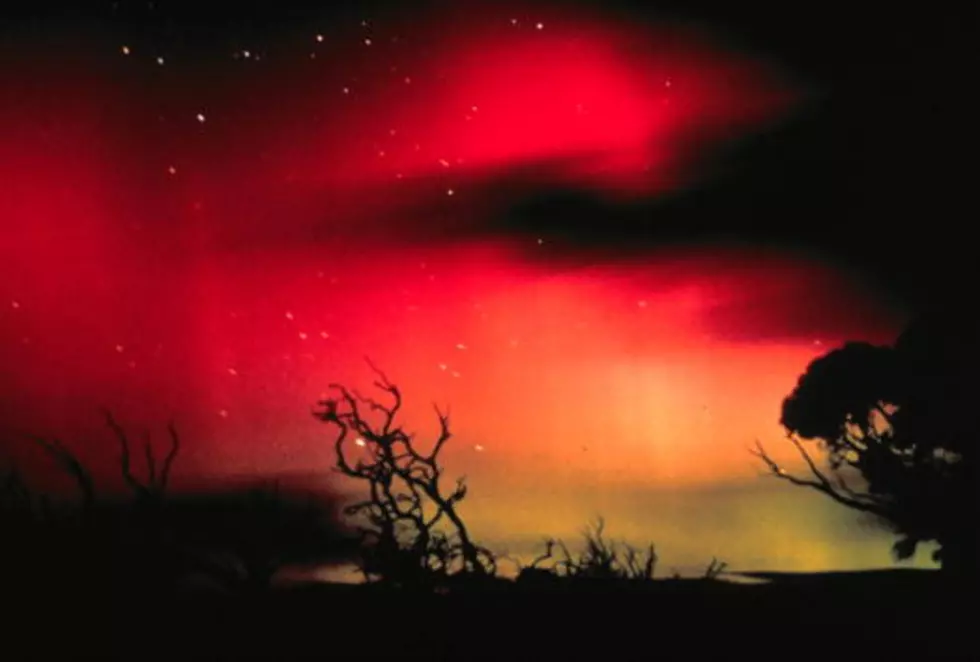
- Don’t expect the blazing, magazine-cover ribbons you see from Alaska. In Illinois, the aurora often appears as a faint green or reddish glow low on the horizon, almost like a distant city on fire. Your phone camera may see more than your eyes at first, so try night mode and a few long-exposure shots.
- During last spring’s big geomagnetic storm, people from Rockford to Madison shared photos of bright pillars dancing overhead, which is proof that the Northern Lights can absolutely show up in our part of the world when the sun gets rowdy enough.
LOOK: These Color Photos Vividly Capture the Everyday Moments of Life in the ’50s and ’60s
Gallery Credit: Stephen Lenz